SpaceX catches Starship’s upper stage at its launch tower for the first time
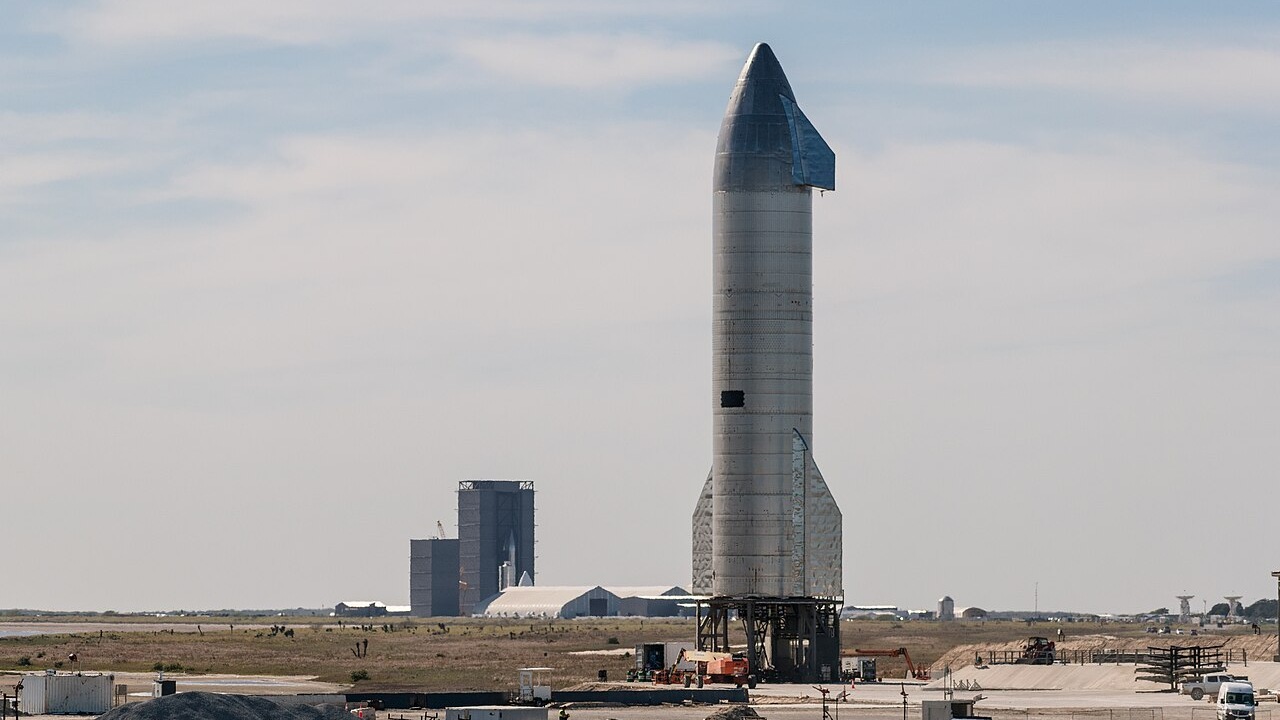
Starship SN9, Texas, 16 January 2021. (Illustrative.) | Jared Krahn; cropped | CC BY-SA 4.0 | https://commons.wikimedia.org/w/index.php?curid=99400216 | https://creativecommons.org/licenses/by-sa/4.0/
SpaceX caught a Starship upper stage returning from orbit for the first time on Saturday 14 November, bringing the spacecraft back to its launch tower in Texas. Reuters and Space.com reported the successful recovery, a significant step towards reusing the whole rocket. Flight 15 nevertheless fell short of its planned double recovery: the Super Heavy booster had failed to return to the tower after launch the previous evening.
An orbital flight ends at the launch tower
Space.com put the catch at 9:20pm GMT on Saturday, or 4:20pm on the US East Coast and 3:20pm in Texas. The vehicle, Ship 42, descended through cloud towards the mechanical arms at SpaceX’s Starbase facility after roughly 22½ hours in flight. The arms supported the spacecraft as its engines shut down.
The distinction between this catch and earlier demonstrations is the journey the vehicle had completed. SpaceX had already recovered Super Heavy on three test flights, Space.com reported. Catching the upper stage required bringing it back from orbit, where it travels higher and faster than the booster. The successful manoeuvre therefore tested a different and demanding part of the recovery sequence.
Before approving the return, the company checked the spacecraft’s heat shield using imagery from satellites and cameras on the ground, according to Space.com. The flight also deployed 26 next-generation Starlink V3 satellites, giving the mission a payload-delivery role alongside its recovery experiment.
Why the booster did not come back
Space.com’s live coverage recorded launch at 10:47pm GMT on Friday 13 November, equivalent to 5:47pm EST. The intended sequence was to recover the booster shortly after liftoff and bring Ship back the following day. Instead, the booster diverted away from the tower, leaving the upper-stage attempt as the remaining opportunity for a catch.
The explanation for that diversion also changed during the mission. In a Saturday update, Space.com reported SpaceX spokesperson Dan Huot’s clarification that the guidance, navigation and control system had functioned as intended. It detected that the booster was not in the correct position for a safe tower return and initiated an abort. The underlying cause remained under investigation.
That correction matters when assessing the flight. A protective system deciding that a landing attempt is unsafe is different from that system itself failing. It does not explain why the vehicle reached the wrong position, and it does not turn the lost booster into a successful recovery.
Recovery is one step towards reuse
Reuters reported that Ship completed 14 orbits before returning. Its account also identified a remaining limitation: the heat shield is not yet fully reusable, and SpaceX is developing tiles intended to need little or no refurbishment between missions. Recovering a spacecraft supplies hardware for inspection; proving that it can fly again with minimal work is a further task.
The commercial comparison is with SpaceX’s Falcon 9. Its first stage can be reused, while its upper stage is discarded after delivering a payload. Starship’s intended operating model extends recovery to both stages. Saturday’s result brings that goal closer, but the two stages have still not been recovered together on one mission.
There are separate hurdles for flights beyond Earth orbit. Reuters noted that Starship must demonstrate fuel transfers between vehicles in space for its planned lunar role. A tower catch does not demonstrate that capability. The immediate achievement is narrower and concrete: an orbital Starship returned to its launch site and was caught, leaving engineers a vehicle to examine as they work towards repeat flights.